I haven't written a lot as of late, as I'm embarked in some overdue reading, and novels and research are sucking up quite a lot of time. I'm advancing on the Battle of Memphis, however, and I hope to post some good news about it not too far from now.
In the meantime, I have finished David Anthony Durham's Hannibal. Pride of Carthage, which I got following a positive review written by Scott Oden in his blog. Up front, I must say I have really enjoyed it. A lot.
I must also say, though, that after reading Gisbert Haef's Hannibal, I was a bit weary of reading this one. Comparisons are hateful, you know. It's, obviously, different. Pretty different, I'd say. But it's a book that can stand his own. My homonimous did a cool job in describing the character's personalities, and it took a very interesting array of POV-characters, hopping from the main characters (the Barcides, the Scipios, and so) to some interesting secondary characters that provide a very interesting perspective. I have liked his way of describing battles, from POV-characters' perspectives, and rarely resorting to the 3rd omniscient narrator, as I usually do. I enjoy displaying the whole range of tactics and the strategical development of the battles to the readers, so they can re-create it on their mind, as if they were a bird flying over the battlefield. It has a lot of advantages, and it makes writing battles easy and passionate. I usually concentrate in each section (left cavalry wing, left infantry wing, center, right infantry wing, right cavalry wing; or vice-versa) like comic-book panels, and then move time forwards and make another loop, until the battle is done. This allows me to be detailed when it's interesting, and vague when nothing interesting is happening. Sometimes I skip sections on purpose, and this lets me play around the battle, exposing it in all its glory and folly. I usually have a POV character in each of the places, that readers know because they have been introduced before, and I move from the eagle to the character so things are clear and fit nicely into the mould.
Durham, however, rarely does this. Most battles are narrated from the POV-characters, and we are informed of what's going on through their eyes and ears. Sometimes we get just one POV per battle-frame. When we get to the last character, the battle ends, from what he or she can perceive. This "stripping" of most of the steps I use to describe a battle is interesting, however, because it makes things more intimate. More . . . "flavorous". It let's you sample enough of the battle each time to make a rough draft of what's going on; you--as a reader--feel the intensity not by the information you have, but precisely by the information you are lacking. It also allows to concentrate more on the inner part of the battle, intimate views and feelings. It's weird, but I think it may make things less . . . exhaustive; more appealing.
Once I finish the novel draft, and alongside the Great Historical Revision (GHR for my friends :) I'll have to review lots of things like these: if a situation will gain value by changing a POV there, deleting this or moving it for a later time in the scene, etc... Once the draft is finished, I'll have to work to make the novel good (or at least as good as I am able to).
This writing bussiness is really complex, but oh so fun! :-)
Happy Autumn (or Fall) for everyone. KALLISTI!
2006-09-27


2006-09-14
Memnon and the Hat
I have finished reading Scott Oden's Memnon, and it was about time!
The veredict? It's very good. Scott has a way of conveying the meaning and feeling of a scene that fills all your senses, you can imagine the whole, re-create it in your mind in full color, sound, smell, and timing.
He's also pretty good at feeling the characters, they look really credible and consistent, you can walk along them and they won't disappoint you, either in dialog or in thoughts or actions. Additionally his prose is rich but not pedant (although I'll have to consult the dictionary for some obscure words), and the reading flows painlessly as worlds unfold before your eyes. I have felt a perceptible improvement over Men of Bronze, which was very good.
I wish I'd be able to write half as crafty as he does!
Things to improve? Yeah, of course. As neo-pagan, I feel a bit nose-shrugged everytime I read such an anachronistic use of the term heathen as Scott uses it... x-D
Anyway, a cool book, the story of an extraordinary man told with dignity and passion, I can only applaud and take my hat off... At thy feet, Sire!
On other bussiness, I have gotten my pawns on a copy of A. T. Olmstead's History of the Persian Empire, it has some really interesting chatpers, and the book looks pretty good, I'll try to put it to a good use on Inaros... :)
I have found Pierre Briant's From Darius to Alexander in French, I have to read it on the Library, and it's 2 volumes... I'll have to unrust my langue d'öil if I want to be able to benefit... Voilà!, another reason to learn languages, uh?
Lastly, as NaNoWriMo approaches, I am honing my skills, probably to tack the last of the book, and maybe the first revision? (or maybe I'll wait for Nanoedmo in March).
Now that I have finished the book, I will try to write again, while reading the other books on the stack, which is already a parasang tall!
Kallisti!
2006-08-22
Holidays
I'm on holidays!
Be back in September! I've passed through the 100,000 words boundary! (Over 400 ms pages!)
And I'm reading Scott Oden's Memnon! Whoo! I love holidays, don't you? :-)
Laters (I may have intermittent Internet access, like right now...)!
KALLISTI!
2006-08-17
I got a story
I have travelled to the web site of Ursula K. Le Guin.
For those who doesn't know, she is a writer. A wonderful writer.
She was the one that introduced me into Science Fiction, with her The Left Hand of Darkness and later with her The Dispossessed. Those are wonderful books, indeed. She also wrote Fantasy, the Earthsea saga. And lots of other wonderful stories (one that comes to mind is The Word for World is Forest, for example).
And I read this small article she wrote a bit ago:Ursula K. Le Guin: What Makes a Story
And my eyes sparked, and the hint of a smile insinuated itself on my face as I became enlightened.
I have a story to tell. I have a space to share, rooms to visit, and different rythms and movements, a variety of offerings to the readers to explore a fragment of our History, and a part of what's made us be the way we are right now.
I have a story that's relevant, that has the potential, if I do my job as writer well enough, to move the readers, to give them ample space and time to re-create themselves in another world, that may provide them something to help them grow a bit more, to become a little bit more conscious of themselves.
I had some doubts about the way I am telling it, and the way it's showing itself, but she is right, I just have to provide the fertile ground, the refreshing water, the nourishing Sunlight, and some gentle breeze to oxigenate it, and the story will flouring, with every reader, from our Past to the Present.
Yes, The Libyan is a story, and I will work to make a great story out of it. Because it deserves to be told, to breath and live and spread, because it's my duty to make it worth of such privilege.
By the way, at the brink of the 100,000 words boundary, I am about to start writing the Battle of Memphis: the parties are moving to their respective places, the players are in front of their cards, the writer knows the script. iaci aleam!
ΚΑΛΛΙΣΤΗ
2006-08-09
Luring the Enemy
Update: $ perl Meta/wc.pl Inaros_more_20060809.txt 2>/dev/null
W: 97925 (MP: 391.7, PP: 195.85), %: 81.6041666666667
gilgamesh@uruk:~/personal/Inaros/2006$
Almost at the 100,000 words boundary... :-)
And, yes, how do you, as a general, manage to lure your enemy into battle? Because the enemy wants not to go, he's not, after all, silly, uh? ;-)
OK, this is the dilemma that Megabyzos is facing at the moment. And the solution he has found is, if I'm allowed to say so, pretty clever.
Pharaoh (Inaros) doesn't want to get out and face the might of the Persian army that routed his siege army at Pelusion, which has managed to surprise them by arriving at Memphis much faster than anyone would think possible, and has joined forces with the army inside the sieged White Castle of Memphis, which is comprimed by the remnants of the Persian army raised to fight at Papremis, and some reinforcements arrived from Upper Egypt (mainly a squadron of Jew fighters from Elephantine).
Pharaoh, therefore, refuses to fight. With the Greek camp by the river, on the North of Memphis, and the main camp set slightly to the Southwest of the town, he can easily counter any attempts to assault any of the sites, to intercept arrivals from the South (for example grounded troops, not by river, as he only controls the Nile from Memphis). And what happens when you, as a young, fiery soldier, who's walked from Tyre, Syria, to Memphis, Egypt (about 800 km according to googleearth) fighting Canaanean rebels, then bandits, desert dwellers, rebel Egyptians, Libyans and Greeks, and then some (real, sand-only) desert travel for over half a year, just to arrive to your destination with your comrades and find out that the enemy doesn't want to fight?
You get angry.
Very angry.
:-)
Tomorrow (if not today) I'll start writing the first games before the Big Clash.
The Battle of Memphis is about to arrive. Rejoice! (sortof)
BELLISSIMÆ
2006-07-31
Advancing
Nod.
Almost 4,000 more words to add to the counter, I'll let you know when I upload them, but the grand totale is approaching the 100,000! (around 95,000).
As this is a happy-happy joy-joy moment, I'll post the promised, fine-grained battle-plan of the Battle of Memphis, as I originally (re-)created it a little over one month ago, when I was celebrating Litha in Alicante.
Ladies and gentlemen, the Battle of Memphis!
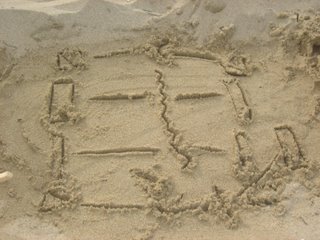
Well, yes, it's drawn in the sand. What did you understand when I talked about "fine-grained"? There are millions of grains of sand in that battle! You can click on the image to get a bigger version and count them yourself!
Ahem. :-)
OK, I would post the battle, but then I would have to kill you (and Google, and...) or risk spoiling a lot of suspense on a novel I'm sure nobody will read :-p
Well, the point is that after a dashing, daring, gasping movement, Bagâbuxsha (i.e. Megabyzos) has managed to catch the rebels unprepared (not exactly "by surprise", but, anyway...) and both parties, led by Faraoh Ienheru (a.k.a. Inaros) and stratégos Kharitymides (rebel side) and generals Bagâbuxsha and Taxmaspâda (Persian side), are getting themselves ready to weep blood-red over the Nile waters with their respective enemies' guts.
Charming.
Not really, but it's lotsa fun writing it (like those videogames where your troops die but you know nobody's really suffering... let's discriminate between current reality and past or ficticious times, shan't we?) and I hope to get through it fairly easily and make a good battle. Then there's only the Prosopitis thingie and the walk through the desert till Cyrene, and back to Athens, and then finishing the Spartan mission (that we left, remember gentle reader, back in the middle of it during Nanowrimo 2005) and we will be left... Probably more than the planned 120,000 words for the draft, but not many more, I guess...
Anyway... Best regards and Blessed Lúnasa (or Lughnassadh) for all that Celebrate!
Bellissimae
Almost 4,000 more words to add to the counter, I'll let you know when I upload them, but the grand totale is approaching the 100,000! (around 95,000).
As this is a happy-happy joy-joy moment, I'll post the promised, fine-grained battle-plan of the Battle of Memphis, as I originally (re-)created it a little over one month ago, when I was celebrating Litha in Alicante.
Ladies and gentlemen, the Battle of Memphis!

Well, yes, it's drawn in the sand. What did you understand when I talked about "fine-grained"? There are millions of grains of sand in that battle! You can click on the image to get a bigger version and count them yourself!
Ahem. :-)
OK, I would post the battle, but then I would have to kill you (and Google, and...) or risk spoiling a lot of suspense on a novel I'm sure nobody will read :-p
Well, the point is that after a dashing, daring, gasping movement, Bagâbuxsha (i.e. Megabyzos) has managed to catch the rebels unprepared (not exactly "by surprise", but, anyway...) and both parties, led by Faraoh Ienheru (a.k.a. Inaros) and stratégos Kharitymides (rebel side) and generals Bagâbuxsha and Taxmaspâda (Persian side), are getting themselves ready to weep blood-red over the Nile waters with their respective enemies' guts.
Charming.
Not really, but it's lotsa fun writing it (like those videogames where your troops die but you know nobody's really suffering... let's discriminate between current reality and past or ficticious times, shan't we?) and I hope to get through it fairly easily and make a good battle. Then there's only the Prosopitis thingie and the walk through the desert till Cyrene, and back to Athens, and then finishing the Spartan mission (that we left, remember gentle reader, back in the middle of it during Nanowrimo 2005) and we will be left... Probably more than the planned 120,000 words for the draft, but not many more, I guess...
Anyway... Best regards and Blessed Lúnasa (or Lughnassadh) for all that Celebrate!
Bellissimae
2006-07-19
Will Write For Chocolate
This is a funny web comic about the writing bussiness and stuff...
I also love chocolate too! :-)
Enjoy and wait for some update in the following days, although I've been reading and thinking more than writing as of late...
KALLISTEE
2006-07-11
Does Latin "train the brain"?
Interesting blog entry about a subject I wrote yesterday (BTW, that blog hasn't been updated in a year, which is a pity):
Weblog - A Don's Life - Times Online: Does Latin "train the brain"?
ΚΑΛΛΙΣΤΗ ΚΑΙ BELLISSIMAE
2006-07-10
Writing Tools (modern?)
Writing tools? Mmm...
The blosphere has made lots of bells and whistles about a Mac application, WriteRoom... It's a full screen application and a simple text editor, to write without distractions.
The boardbox/laptop equivalent of the AlphaSmarts, only simpler. Other offers have quickly sprouted here and there. Dark Room is a .NET equivalent for the Windows OS (I don't think it may run on the Mono free software framework on UNIX). Followed suitely by JDarkRoom, the Java equivalent (which is not working on my GNU/Linux box with Sun Java 1.4.2).
It's cool to get better productivity. But we have had that for years. For lots of years.
Enter the GNU/Linux console (or the Free/Open/Net-BSD console!):
a) Full screen.
b) Multitasking nevertheless.
HOWTO: Fire up VI (or Emacs; I prefer ViM, but you can choose among 1,000 text editors) and you have all the power of UNIX at your command. A simple, dumb editor? It's nice to write, but why ask for less when you can have the full screen power of UNIX, easier and more reliably???
I think we are living the Mac fad, which is Mac/Apple (re-)inventing everything again... Well, yeah. Paraphrasing the Inmortal F. Mercury: I want to break free.
ΚΑΛΛΙΣΤΗ
Links:
* ViM rules, and if you use GNU Screen you'll have all the productivity you need.
* EMACS is loved by many.
* Write Room
* Dark Room
* JDark Room
* Open Office has a Full-Screen mode
* Abiword has one too.
* LyX is a favourite of mine, and you can get full screen as well.
PS- Actually, this Write Room offers nothing (and seriously less than what) you couldn't have 20 or 30 years ago with any UNIX, or even some 15 years ago with DOS on a small PC (and let's not start with the Amiga, etc...).
Subscribe to:
Posts (Atom)


